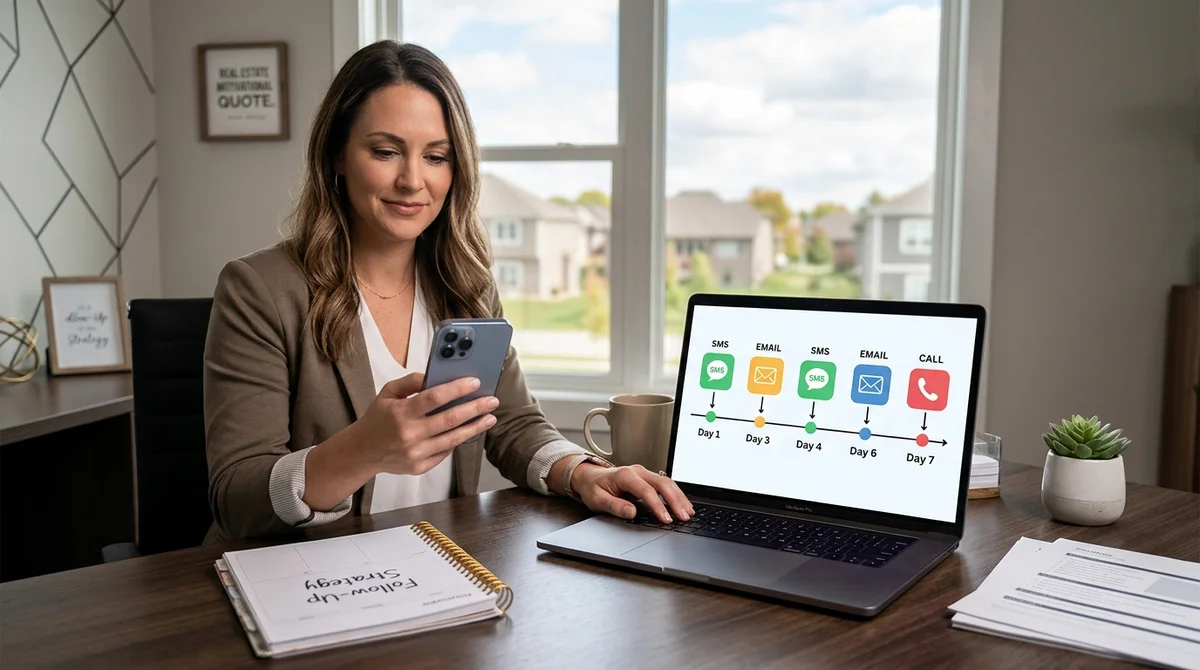
Why Most Follow-Up Sequences Fail
The average investor's follow-up looks like this: text once, maybe call once if they remember, then the lead quietly goes cold. It's not that the message was wrong — it's that there was only one touch, on one channel, with no real plan behind it.
Data from SMS marketing platforms consistently shows that most replies to a first text come within the first few minutes, but a meaningful chunk of eventual conversions come from touch three, four, or five — not touch one. A lead who doesn't respond to your first text isn't necessarily uninterested. They might have been driving, at work, or just not ready that exact moment. The investors who win aren't the ones with the cleverest opening line — they're the ones with a system that keeps showing up, on the right channel, at the right time, without becoming annoying.
The 7-Day Sequence
This sequence deliberately alternates channels instead of hammering the same one. Each channel does a different job — SMS gets attention fast, email gives room for detail, and the call is reserved for the moment someone has already shown real interest.
Day 1 — SMS (Same Day as Lead Comes In)
Speed matters more than almost anything else in this sequence. Text within the first hour if you can. Keep it short, plain, and easy to reply to with one word — the goal of message one is just to start a conversation, not to close anything.
Day 2 — Email
If there's no reply to the text, send an email the next day. This is where you can actually explain who you are and what you're offering — something that doesn't fit naturally into a text. Email is also the channel least likely to feel intrusive on day two, since you've only reached out once before.
Day 4 — SMS (Different Angle)
Skip a day, then text again — but change the angle instead of repeating yourself. If your first text asked a direct question, try leading with value this time: a specific number, a timeline, or something that addresses a common objection. The goal is to make it obvious this isn't an automated blast, even though it's part of a system.
Day 6 — Email (Social Proof or Specifics)
By the second email, generic intro language has already been said. Use this one to get concrete — a real example, a specific number, or something that answers the question a hesitant lead is actually asking themselves ("is this worth my time?").
Day 7 — Phone Call
The call goes last, not first, on purpose. By day 7, anyone who's replied to a text or opened an email has already shown you something a cold list never gives you — actual engagement. That's the moment a call is worth the time it takes, and it's also the point where hearing a real voice can move someone who's been on the fence through five days of text and email.
What To Do With Non-Responders After Day 7
Not everyone responds in a week, and that's normal — real estate decisions often take longer than a sales cycle wants them to. Rather than continuing to push daily, move non-responders into a slower, longer-term nurture cadence — something like one text every few weeks — instead of either giving up entirely or continuing to contact them every day. Both extremes cost you deals: one by abandoning a lead too early, the other by becoming the contact people block.
Automating This Without Losing the Personal Touch
None of this requires manually tracking who's on day 2 versus day 6 in a spreadsheet. The sequence itself is what matters — the specific tool you use to run it is secondary, but a few things make it actually sustainable instead of something you do for a week and abandon:
- Personalization tags (name, address, or whatever detail you have) so messages don't read as obviously templated, even at scale.
- A shared view of replies across channels — if someone responds to your day-4 text, you shouldn't still send them the day-6 email as if nothing happened.
- Scheduling that runs on its own, so day 4 and day 6 actually go out on day 4 and day 6, not whenever you remember.
Investor Lead System handles all three of these directly — SMS Campaigns and Email Campaigns run from the same lead list, replies show up in one inbox instead of two separate ones, and scheduled messages send automatically on the day and time you set, correctly converted to your own timezone.
One compliance note: every message in a sequence like this still needs to follow the same consent and opt-out rules as any other SMS or email outreach. See our guide to texting leads without violating TCPA if you haven't already.
Create a free account and set up your first sequence, or see pricing for the full breakdown across plans.