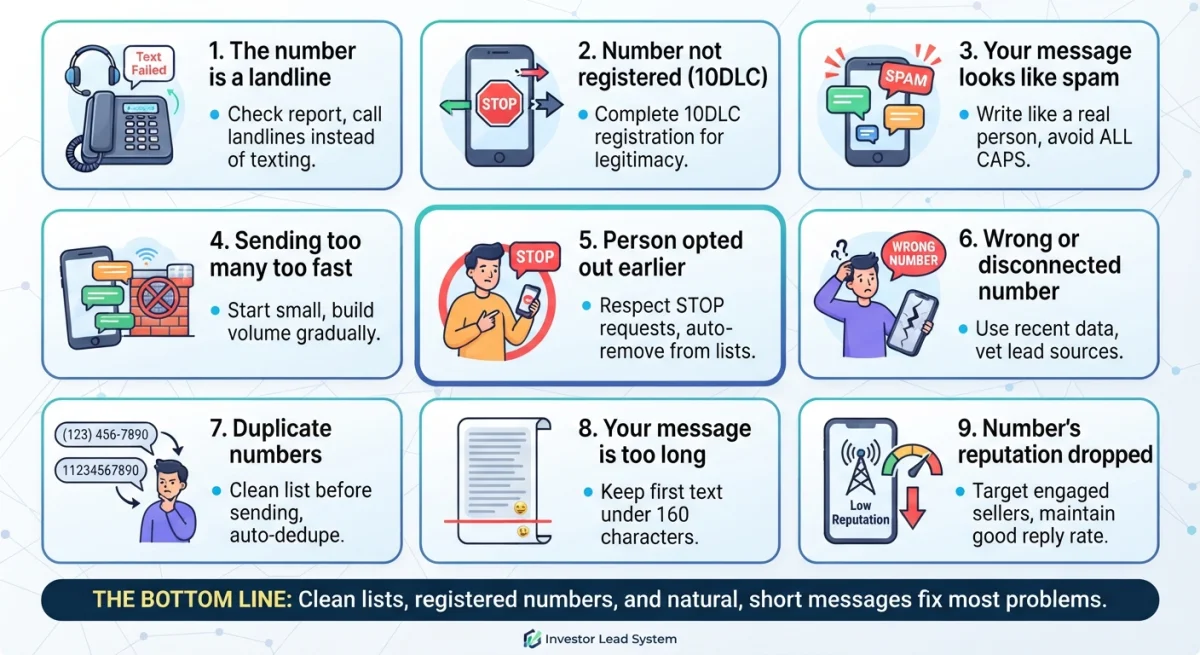
You wrote a great message, uploaded your list, and hit send. Then you waited, and almost nobody replied. It's easy to assume the message was the problem. But very often, the real problem is that a big chunk of your texts never reached anyone's phone at all.
Text delivery isn't guaranteed. Between you and the seller sit the mobile carriers, and they filter business texts heavily. Here are the nine most common reasons real estate texts fail to deliver, and what you can do about each one.
1. The number is a landline
This is the most common cause by far, especially with skip-traced and older lists. Many numbers attached to property records are home landlines or office lines, and landlines can't receive texts. The carrier rejects the message, usually with an error such as "the destination number is a landline or a non-routable wireless number."
Fix: Expect a portion of any list to be landlines. Check your campaign's delivery report, note which numbers failed, and call those instead of texting them. Good software shows you exactly which numbers failed and why, and doesn't charge you for texts that never went out.
2. Your number isn't registered for business texting
Carriers require businesses to register their brand and campaign before texting from a regular local number, a system known as 10DLC. Unregistered texts are treated as suspicious and are often filtered or blocked without any warning to you.
Fix: Complete your business and campaign registration before sending at volume. Once approved, your messages are recognized as legitimate and you get higher daily sending limits.
3. Your message looks like spam
Carrier filters scan message content. Some patterns trigger them quickly:
- ALL CAPS or lots of exclamation marks
- Phrases like "cash offer today," "act now," or "guaranteed"
- Dollar signs and big money amounts in the first text
- Public link shorteners such as bit.ly
- The exact same message blasted to thousands of people at once
Fix: Write the way a real person texts. Use the seller's name, mention the property, ask one simple question, and leave the offer for later in the conversation.
4. You're sending too many texts too fast
Every registered number has a daily sending limit, and sudden spikes in volume look like spam to carriers. A brand-new number that sends thousands of texts on day one is very likely to get filtered.
Fix: Start with smaller batches and build up gradually. Spread larger campaigns over several days, or across more than one number.
5. The person opted out earlier
When someone replies STOP, both your system and the carrier block future texts to that number. If the same person shows up on a new list, the message is refused, which is exactly what should happen.
Fix: This one isn't a problem to solve. Opt-outs must be respected. Just make sure your platform removes opted-out numbers before sending, so you aren't charged for texts that can't go out.
6. The number is wrong or no longer in service
Lists go stale fast. People change numbers, and data sources make typing mistakes. A number that's one digit off, or one that was disconnected last year, will simply fail.
Fix: Use recent data, and look at the delivery report after each campaign. If a source keeps producing failed numbers, stop buying from it.
7. Duplicate numbers in your list
Duplicates don't usually cause failures, but they cause something almost as bad: texting the same person twice in a row. That annoys sellers, increases opt-outs, and those complaints hurt your number's reputation with carriers.
Fix: Clean your list before uploading, or use software that automatically treats the same number as one contact, even when it's written differently, such as (405) 465-9561 and +14054659561.
8. Your message is too long
A standard text is 160 characters. Longer messages are split into parts and cost more. Emojis and some special characters switch the message to a different format that allows only 70 characters per part. Very long, multi-part messages are more likely to be filtered and less likely to be read.
Fix: Keep your first text short, ideally under 160 characters. Save the details for when the seller replies.
9. Your number's reputation has dropped
Carriers track how people react to your texts. High opt-out rates, spam reports and very low reply rates all lower your number's reputation, and over time more of your texts get filtered.
Fix: Text people who are likely to want to hear from you, send relevant messages, and reply quickly when someone answers. A good reply rate is the best signal you can send carriers.
Frequently asked questions
How do I know if my texts were delivered?
Check your campaign's delivery report. It should show how many texts were sent, how many failed, and why. A "sent" message only means it left your system; the delivery status confirms whether the carrier accepted it.
What is a normal delivery rate for real estate texting?
It depends heavily on your list. A clean list of mobile numbers from sellers who expect to hear from you delivers far better than an old skip-traced list full of landlines. If many texts in a campaign fail, the list is usually the reason.
Do I pay for texts that fail?
That depends on the platform. With Investor Lead System, texts that fail, plus numbers that are skipped because they opted out or were blocked, are refunded to your wallet automatically.
Why did my texts deliver last week but not this week?
Usually because something changed: a new list with more landlines, a different message that triggers filters, or a jump in sending volume. Compare the two campaigns and look for what's different.
Can I text from a toll-free number instead?
Yes, but toll-free numbers need their own verification before business texting, and many sellers trust a local number more. Most investors use local numbers registered for 10DLC.
The bottom line
When a campaign underperforms, check delivery before rewriting your message. Clean lists, a registered number, steady sending volume and natural, short messages fix most delivery problems.
Investor Lead System shows exactly how many texts were delivered and failed for every campaign, removes duplicates and opted-out numbers automatically, and refunds texts that don't go out. Create your account and see where every text in your next campaign ends up.