What a Missed Call Really Costs Real Estate Investors
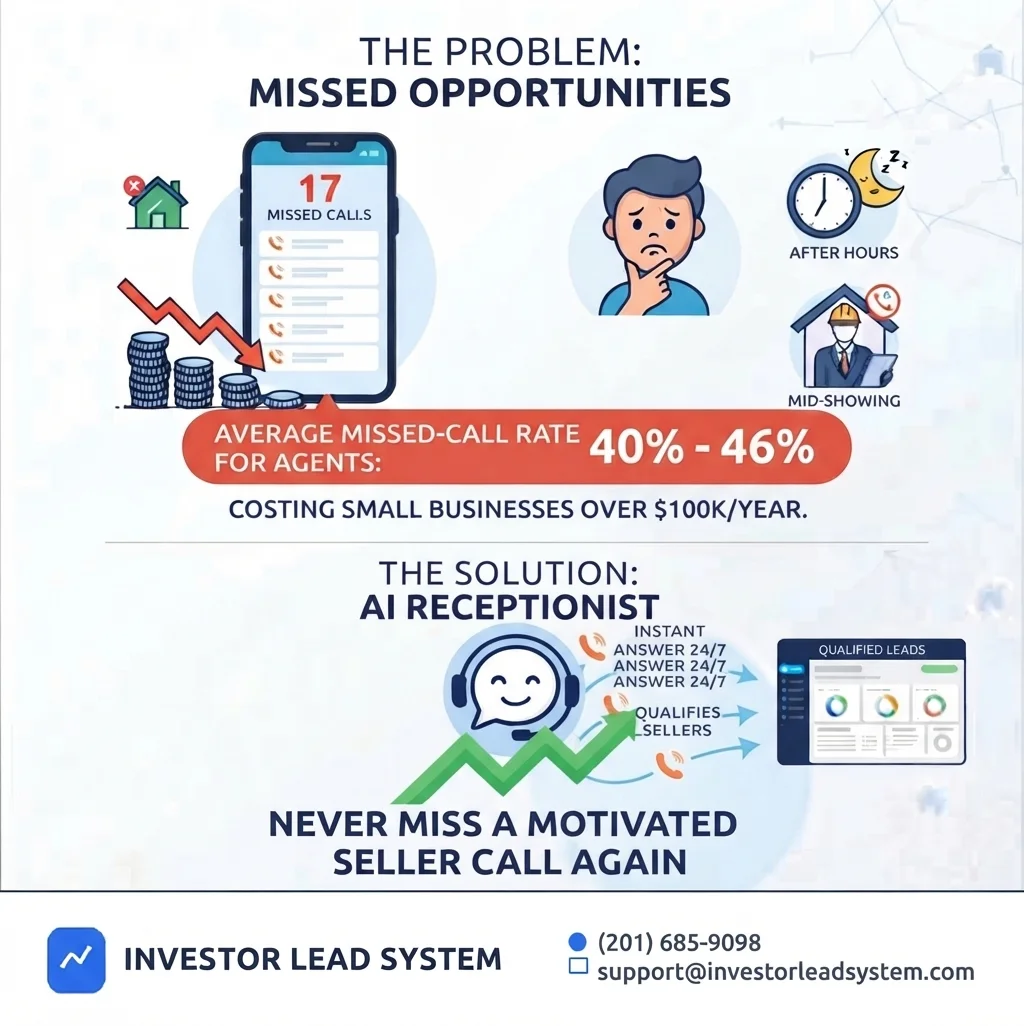
Studies put the average missed-call rate for real estate agents and investors between 40-46%, with industry cost estimates topping $100,000 a year in lost business for the average small business. Here is how to calculate what missed calls are actually costing your pipeline, why voicemail no longer solves this, and how AI-driven call answering closes the gap without a full-time hire.
Quick question: when's the last time you actually checked how many calls you missed last month?
Not the ones you called back. The ones that just... disappeared. No voicemail, no callback number written on a napkin, nothing. Just a notification you swiped away because you were mid-showing, mid-drive, or already on another call.
Here's the uncomfortable part: research on real estate call handling puts the average missed-call rate for agents and investors somewhere between 40% and 46%. Not occasionally missed. Nearly half. And industry cost analyses estimate the average small business loses somewhere north of $100,000 a year in business that simply walked to whoever picked up first.
If you've never actually run the math on what that's costing you specifically, it's worth five minutes. The number is almost always bigger than people expect.
Why the math is worse in real estate specifically
Missed calls are expensive for any business. They're brutal for real estate investors for one specific reason: the person calling you is very often calling three or four other people the same afternoon.
A motivated seller who found your number on a "we buy houses" sign isn't going to wait around. If your phone goes to voicemail, they move to the next number on their list — and by the time you call back that evening, they've likely already talked to someone who picked up live.
Layer onto that the fact that a large share of inbound real estate calls — widely estimated at somewhere around half — come in outside normal business hours. Evenings, weekends, the 20 minutes you're actually inside a property with no signal. That's not a scheduling inconvenience. That's the exact window where a chunk of your pipeline is trying to reach you and can't.
Why voicemail doesn't actually solve this
The instinct is to think "well, that's what voicemail is for." Here's the problem: almost nobody leaves one anymore. A missed call with no message just becomes a mystery number you have to call back blind, with zero context on who it is, what they want, or whether they're even still interested by the time you reach them.
Voicemail was built for a world where people were comfortable leaving a message and waiting. That's not the world motivated sellers are calling from in 2026 — they want an answer now, or they're calling the next number.
Doing the actual math on what this costs you
Here's a simple way to run your own number, rather than relying on an industry average that may not match your situation:
(Calls missed per month) × (your realistic close rate on live-answered leads) × (your average deal value) = what missed calls are actually costing you.
Even a modest volume adds up fast. If you're missing just 10 calls a month, closing even 1 in 20 of those, and your average deal nets $8,000 — that's one lost deal roughly every other month, purely from calls that never got answered live. Most investors running this number for the first time are surprised it's not smaller.
The two real options: hire someone, or automate the answer
Historically there were two ways to fix this: hire a receptionist, or accept the leakage as a cost of doing business. A full-time receptionist runs somewhere in the $35,000–$45,000/year range once you include benefits — a real, meaningful cost for a solo investor or a small team, and one that still only covers one line, during business hours, unless you're paying for shift coverage on top of that.
The alternative that's changed the math entirely over the last couple of years is AI-driven call answering — a system that picks up every call, in real time, without ever going to voicemail, at a small fraction of what a human hire costs.
What this actually looks like day-to-day
This is exactly the gap Investor Lead System's AI Receptionist is built to close — not as a generic voicemail replacement, but as an active first responder on every inbound call:
Answers instantly, 24/7: no more "the call that got away" because it landed at 9pm or during a showing — every call gets picked up the moment it comes in, not routed to voicemail as a fallback.
Asks the questions that actually qualify a seller: property condition, timeline, motivation to sell — the same information you'd ask yourself, captured before you ever call back.
Logs straight into Lead Management: no scrawled napkin notes or guessing who called — every conversation lands in your dashboard with the caller's answers already attached.
Only surfaces genuinely interested callers: not every caller becomes a lead in your pipeline — only the ones who show real interest or ask for a follow-up do, so you're not sorting through noise to find the people worth calling back.
You still make the actual sales conversation happen — the AI's job is making sure you get the chance to, instead of finding out three days later that a motivated seller called while you were unreachable.
Quick answers to what people ask most
Can callers tell they're talking to an AI?
Often not right away — modern conversational AI has gotten good enough that a meaningful share of callers can't immediately distinguish it from a human. Either way, what actually matters to the caller is getting a real, useful answer instead of a ring-out.
What if a caller is furious or the situation is sensitive?
Calls that clearly need a human touch can be set to transfer straight through, so you're not relying on AI to handle every situation — just the ones it's actually built for.
Is this only useful for solo investors, or does it help teams too?
Both. A solo investor gets coverage they physically can't provide alone. A team gets relief from the exact hours (lunch rushes, after-hours spikes) where call volume tends to overwhelm whoever's on phone duty.
Doesn't a real conversation convert better than an AI one?
A live human conversation with the right person, at the right time, is always the goal — the AI's entire job is making sure that conversation happens at all, instead of a lead going cold because nobody picked up.
The number worth sitting with isn't "how good is my follow-up once I have a lead" — it's how many people never became a lead in the first place, because the call simply wasn't answered. That's a fixable problem, and increasingly, it's one investors are fixing automatically instead of accepting as the cost of being busy.
Ready to fill your pipeline?
SMS campaigns, cold calling, and lead management — all in one dashboard.
Create Your Free Account