The 5-Minute Rule: Why Slow Follow-Up Costs You Sales
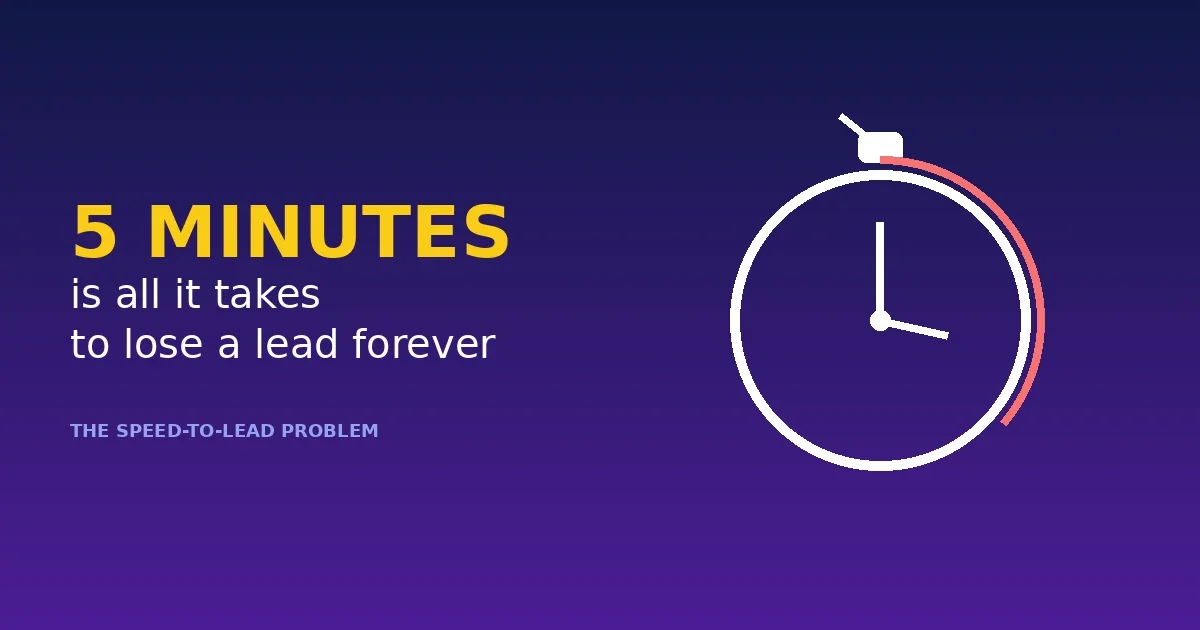
Research shows leads contacted within 5 minutes are dramatically more likely to convert — here's how sales automation closes that window automatically, even while you sleep.
Most sales teams don't lose deals because their product is worse, or their price is too high. They lose them because a lead sat untouched for a few hours — and by the time someone finally called back, that person had already moved on.
This isn't a minor inefficiency. It's one of the most well-documented, most expensive problems in sales, and almost nobody fixes it, because fixing it manually is exhausting. Fixing it with automation is not.
The problem, in numbers
Researchers at MIT studied how response time affects whether a lead ever gets qualified at all. The finding was stark: businesses that reach out within five minutes of a lead coming in are dramatically more likely to actually make contact — and far more likely to qualify that lead — than businesses that wait even thirty minutes.
A separate analysis of millions of real sales calls found something just as striking: calling a lead back within one minute converts far better than waiting just one extra minute, let alone one extra hour. Every minute that passes after a lead reaches out is a minute their interest cools and a competitor's message lands in their inbox instead.
And yet, most businesses aren't close to fast. Independent studies have repeatedly found that a large share of inbound leads never get a response at all, and that average response times across industries are measured in hours, not minutes — sometimes over a full day.
Here's the part that should change how you think about this: this isn't a hiring problem. You don't need more reps sitting by the phone around the clock. You need the first response — the one that matters most — to happen automatically, the moment the lead shows up.
Why manual follow-up always loses this race
Even a great sales team is still a team of humans, and humans have meetings, lunch breaks, and time zones. A lead who calls at 9pm, or texts back on a Saturday, or fills out a form while your rep is mid-call with someone else, is a lead who's already waiting by the time anyone's free.
Sales automation isn't about replacing your team's judgment on a real conversation — it's about making sure nobody ever has to wait for that conversation to start. That distinction is the whole game.
What actually closes the gap
Three things consistently show up in research as the highest-leverage places to automate a sales process, and — not by coincidence — they map directly onto what actually breaks down in most small teams:
Instant call answering. A missed call is a lead lost to whoever picks up next. An AI Receptionist that answers every inbound call immediately — day or night, weekends included — means a 'missed call' simply stops existing as a category. It collects the caller's name and contact info, asks the right qualifying questions, and flags anyone who wants a follow-up straight into your lead list automatically.
Instant text follow-up. The moment a new lead comes in — from a call, a campaign reply, or a scraped list — an automated SMS follow-up can go out before a human would even have opened their laptop. Investor Lead System's bulk and instant SMS tools handle this without you writing a single message by hand each time.
One place where nothing falls through the cracks. Speed only matters if the lead doesn't then get lost in a spreadsheet, a notes app, and three different phones. Centralized Lead Management — with every call, text, and reply automatically logged against the same contact — is what makes fast responses actually turn into closed deals instead of just fast dead ends.
What this looks like day to day
A lead texts your number at 11pm asking about a property. Your AI Receptionist would have already answered if they'd called instead — but since they texted, an automated reply goes out within seconds, keeping the conversation alive. By morning, that reply is already sitting in your Leads Management dashboard, marked unread, with everything the AI could gather already attached to the contact. No lead sat waiting. No rep had to be awake at 11pm to make it happen.
That's the actual definition of sales automation that works: not fewer humans, just zero dead air between 'a lead showed interest' and 'someone — or something — responded.'
Where to start
You don't need to automate everything at once. Start with the single biggest leak: however your leads currently arrive — cold calls, inbound texts, a scraped list — pick the one channel where follow-up is slowest today, and put an automated first response in front of it. For most teams, that's either an AI Receptionist catching calls you'd otherwise miss, or an instant SMS campaign replying to new leads before a human gets the chance to fall behind.
Everything else — cold calling straight from your browser, email campaigns, tracking every reply in one dashboard — compounds from there. But the five-minute window is where deals are actually won or lost, and it's the cheapest problem on this list to fix.
Ready to fill your pipeline?
SMS campaigns, cold calling, and lead management — all in one dashboard.
Create Your Free Account