Hi ,
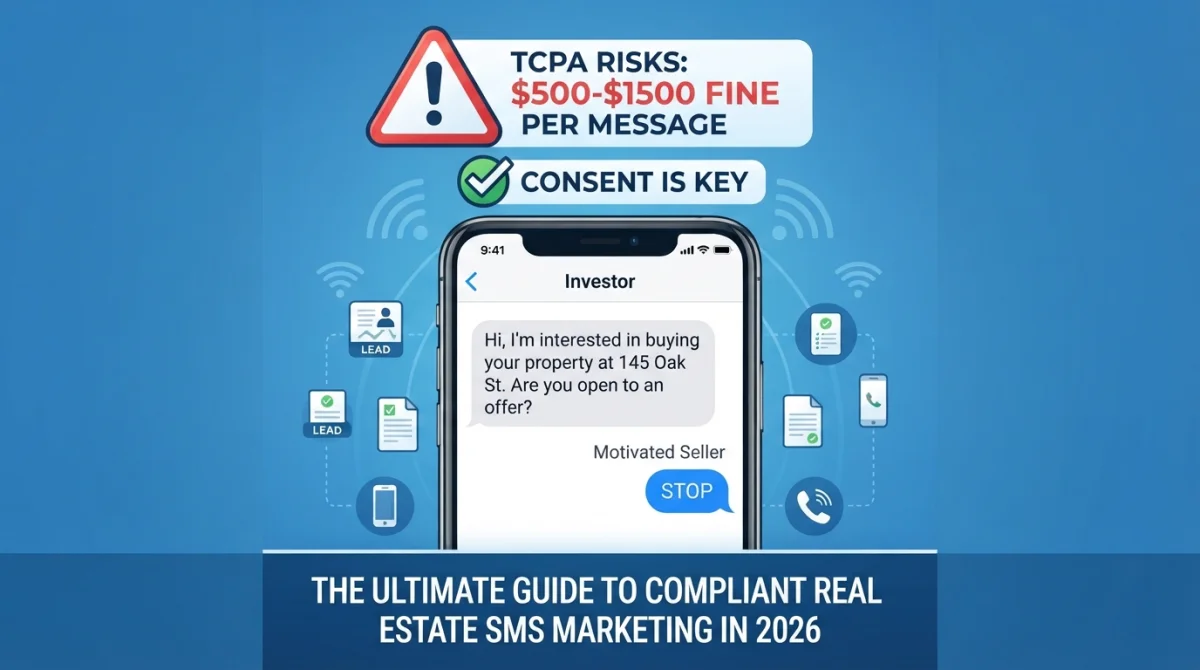
If you've ever hovered over the "Send" button on a text campaign and wondered, "Wait — am I actually allowed to do this?" — you're not alone. It's one of the most searched questions among real estate investors right now, and for good reason: getting it wrong doesn't just mean an annoyed lead. It can mean a $500 to $1,500 fine per message, with no cap on how many messages count against you.
The good news: texting motivated sellers is legal, effective, and still one of the fastest ways to reach someone who isn't sitting in anyone's Zillow funnel. You just need to do it the right way. Here's the complete picture — no legal jargon, just what you actually need to know and do.
The short answer: yes, but only with consent
Text message marketing to consumers, including real estate leads, is governed by the Telephone Consumer Protection Act (TCPA) at the federal level, plus a growing patchwork of state-level rules. The core requirement hasn't changed in years: you need prior express consent before sending a marketing text to someone's cell phone.
What's changed — and what's driving all the search traffic on this topic in 2026 — is how strict enforcement has gotten, and how the rules around revoking that consent now work. Filings related to TCPA violations climbed sharply at the start of this year, and real estate is an easy target specifically because so many investor lists get passed around, inherited from old team members, or bought from a vendor whose consent records nobody can actually verify.
What actually counts as valid consent
This is where most investors get tripped up. A phone number showing up in a lead list, a skip-traced file, or an inherited spreadsheet is not consent. Consent needs to be traceable back to an action the person themselves took — filling out a form on your site, replying to an inbound inquiry, or explicitly opting in through a clearly worded checkbox that says what they're agreeing to receive.
If you can't point to the exact moment someone said yes, the safest assumption is that you don't have consent to text them yet — even if they're a highly motivated seller who'd probably love to hear from you.
The 10-business-day opt-out rule
Once someone asks to stop hearing from you, the clock starts. Current rules require you to honor that request within 10 business days, and — this is the part that surprises people — it doesn't have to arrive as the word "STOP." A reply like "please don't text me again," a comment on your social media, or an email asking to be removed all count as a valid, reasonable revocation. If a lead reaches out to opt out through any channel, you're expected to honor it.
This is exactly why manually managing a text list in a spreadsheet gets dangerous fast. It's not enough to react to "STOP" — you need a system that actually watches for it and shuts off future messages automatically, the moment it happens, across every campaign that lead is part of.
A2P 10DLC: the registration step everyone skips
Application-to-Person 10-Digit Long Code, or A2P 10DLC, is the carrier-level registration system that tells Verizon, AT&T, and T-Mobile who's actually sending business text messages and why. Skip it, and two things happen: your messages get filtered or blocked before they ever reach the lead, and you're operating with essentially zero protection if a compliance question ever comes up.
Registration is inexpensive and doesn't take long — there's genuinely no good reason to send bulk SMS without it in 2026.
Don't forget state-level rules
The TCPA is the federal floor, not the whole picture. Several states run their own no-call registries and texting statutes layered on top — meaning a message that's compliant federally can still violate a state rule if you're texting into that state. If you invest across multiple states, this is one more reason a manual, spreadsheet-based approach becomes genuinely risky at any real scale.
How this actually looks day-to-day with the right system
None of this has to mean giving up on texting — it just means the follow-up and record-keeping needs to be automatic, not something you're trying to remember to do manually. This is exactly why Investor Lead System handles the parts that create the most legal exposure automatically, not as an afterthought:
- STOP-keyword handling: the moment a lead replies STOP (or several other common opt-out phrasings), they're automatically excluded from every future campaign — no manual list-scrubbing required.
- Two-way inbox: every reply lands in one place, so an opt-out request sent in plain English, not just "STOP," doesn't get missed in a sea of individual conversations.
- Dedicated phone numbers: every plan includes a real, registered number for texting and calling — not a shared address that makes it harder to trace consent and history back to a specific conversation.
- Lead Management with full history: every message, call, and status change lives against that lead's record, so if a compliance question ever comes up, you have an actual paper trail instead of a guess.
Compliance isn't just about avoiding fines, either — it's genuinely good for your response rates. Carriers are more likely to filter messages from senders with high complaint rates, so the same habits that keep you compliant (real consent, easy opt-outs, a registered number) also keep your messages actually landing in front of people.
Quick answers to what people ask most
Can I text a number I found through skip tracing?
Not for marketing purposes, unless you separately have their consent. Skip tracing finds a number — it doesn't create permission to contact it.
Does "STOP" have to be the exact word used?
No. Any reasonably clear request to stop counts, and needs to be honored the same way.
What if I bought my list from a lead vendor?
Buying a list doesn't transfer clean consent with it. Ask any vendor directly how consent was collected and whether they can document it — if they can't give you a straight answer, treat the list as cold.
Is cold calling safer than texting?
Not really — cold calling carries its own TCPA exposure and increasingly requires documented consent too. Neither channel is a shortcut around consent requirements.
Texting is still one of the highest-response channels available to investors in 2026 — it just has to be built on real consent, real records, and a system that actually enforces opt-outs instead of hoping someone remembers to update a spreadsheet. Get that foundation right, and SMS keeps being one of the fastest ways to reach a motivated seller before anyone else does.
This article is intended as a general operational overview, not legal advice. Compliance requirements can vary by state and change over time — when in doubt, check your specific calling and texting practices with an attorney familiar with TCPA law in the states where you invest.